 Add to Chrome
 Add to Firefox
 Add to Edge
Bridging Requirements and Architecture: Multi-Agent Orchestration with External Knowledge and Hierarchical Memory
May 31, 2026
Software architecture design is a critical yet inherently complex and knowledge-intensive phase that requires balancing competing quality attributes and adapting to evolving requirements. Traditionally, this process has been time-consuming, labor-intensive, and heavily reliant on architects, often resulting in limited exploration of alternative architectural decompositions and styles, especially under the pressures of agile development. While LLM-based agents have shown promising performance across various software engineering tasks, their application to architecture design remains relatively scarce and requires systematic exploration. To address these challenges, we proposed MAAD (Multi-Agent Architecture Design), a knowledge-driven framework that orchestrates four specialized agents (i.e., Analyst, Modeler, Designer and Evaluator) to autonomously and collaboratively transform requirements specifications into comprehensive, multi-view architectural blueprints with quality attribute assessments. MAAD incorporates RAG to inject recognized architectural standards and patterns into the workflow and leverages a hierarchical memory mechanism that captures design history for iterative refinement. We evaluated MAAD through comparative experiments against MetaGPT, using quantitative architecture-level metrics across 10 case studies and qualitative feedback from industry architects on 10 real-world specifications. Results show that MAAD generates more complete, modular, and traceable architectures than the baseline, and its dedicated Evaluator agent autonomously produces structured quality evaluation reports that significantly reduce manual validation efforts. Furthermore, we found that the quality of the generated architecture heavily depends on the underlying LLM's reasoning capacity, with GPT-5.2 and Qwen3.5 outperforming other models across most evaluation settings.

CODESKILL: Learning Self-Evolving Skills for Coding Agents
May 25, 2026Coding agents produce rich trajectories while solving software-engineering tasks. To enable agent self-evolution, these trajectories can be distilled into reusable procedural skills that compactly encode experience to guide future behavior. However, existing skill construction and maintenance methods often rely on fixed prompts and heuristic update rules, leaving it unclear how knowledge should be selected, abstracted, and maintained to best serve downstream agents. We propose CODESKILL, an LLM-based framework that reformulates skill extraction and skill-bank maintenance as a learnable management policy. CODESKILL extracts multi-granularity procedural skills from coding-agent trajectories, evolves skills with new experience, and maintains a compact skill bank for future task solving. We train CODESKILL with reinforcement learning, using a hybrid reward that combines dense rubric-based skill-quality feedback with sparse verifiable execution feedback from the frozen downstream agent. Experiments on EnvBench, SWE-Bench Verified, and Terminal-Bench 2 show that CODESKILL improves average pass rate by 9.69 over the no-skill baseline and by 4.01 over the strongest prompt-based or memory baseline, while maintaining the skill bank at a stable size during iterative construction.
Reflection Anchors for Propagation-Aware Visual Retention in Long-Chain Multimodal Reasoning
May 10, 2026Long chain-of-thought (CoT) reasoning improves large vision--language models, but visual information often fades during generation, limiting long-horizon multimodal reasoning. Existing methods either re-inject vision at inference or train policies for stronger grounding, but where to intervene relies on perception heuristics rather than principled gain analysis, and how local visual influence propagates remains implicit. We study this problem from an information-theoretic standpoint and derive a lower bound on the downstream visual gain of a one-step intervention, which suggests two factors: local branching room (token entropy) and downstream visual propagation potential (suffix divergence from a vision-marginalized reference). Guided by this analysis, we propose reflection-anchor policy optimization (RAPO), a GRPO-based policy optimization method that selects high-entropy reflection anchors and optimizes a chain-masked finite-window KL surrogate for downstream visual dependence. Experiments on reasoning-intensive and general-domain benchmarks show that RAPO delivers substantial gains over strong baselines across multiple LVLM backbones. Mechanism analyses further indicate that reflection anchors are enriched for visually sensitive decision points and that RAPO increases contrastive visual-dependence signals along generated trajectories.
Cost-optimal Sequential Testing via Doubly Robust Q-learning
Apr 13, 2026Clinical decision-making often involves selecting tests that are costly, invasive, or time-consuming, motivating individualized, sequential strategies for what to measure and when to stop ascertaining. We study the problem of learning cost-optimal sequential decision policies from retrospective data, where test availability depends on prior results, inducing informative missingness. Under a sequential missing-at-random mechanism, we develop a doubly robust Q-learning framework for estimating optimal policies. The method introduces path-specific inverse probability weights that account for heterogeneous test trajectories and satisfy a normalization property conditional on the observed history. By combining these weights with auxiliary contrast models, we construct orthogonal pseudo-outcomes that enable unbiased policy learning when either the acquisition model or the contrast model is correctly specified. We establish oracle inequalities for the stage-wise contrast estimators, along with convergence rates, regret bounds, and misclassification rates for the learned policy. Simulations demonstrate improved cost-adjusted performance over weighted and complete-case baselines, and an application to a prostate cancer cohort study illustrates how the method reduces testing cost without compromising predictive accuracy.
SemEval-2026 Task 9: Detecting Multilingual, Multicultural and Multievent Online Polarization
Apr 08, 2026We present SemEval-2026 Task 9, a shared task on online polarization detection, covering 22 languages and comprising over 110K annotated instances. Each data instance is multi-labeled with the presence of polarization, polarization type, and polarization manifestation. Participants were asked to predict labels in three sub-tasks: (1) detecting the presence of polarization, (2) identifying the type of polarization, and (3) recognizing the polarization manifestation. The three tasks attracted over 1,000 participants worldwide and more than 10k submission on Codabench. We received final submissions from 67 teams and 73 system description papers. We report the baseline results and analyze the performance of the best-performing systems, highlighting the most common approaches and the most effective methods across different subtasks and languages. The dataset of this task is publicly available.
GeoChemAD: Benchmarking Unsupervised Geochemical Anomaly Detection for Mineral Exploration
Mar 13, 2026Geochemical anomaly detection plays a critical role in mineral exploration as deviations from regional geochemical baselines may indicate mineralization. Existing studies suffer from two key limitations: (1) single region scenarios which limit model generalizability; (2) proprietary datasets, which makes result reproduction unattainable. In this work, we introduce \textbf{GeoChemAD}, an open-source benchmark dataset compiled from government-led geological surveys, covering multiple regions, sampling sources, and target elements. The dataset comprises eight subsets representing diverse spatial scales and sampling conditions. To establish strong baselines, we reproduce and benchmark a range of unsupervised anomaly detection methods, including statistical models, generative and transformer-based approaches. Furthermore, we propose \textbf{GeoChemFormer}, a transformer-based framework that leverages self-supervised pretraining to learn target-element-aware geochemical representations for spatial samples. Extensive experiments demonstrate that GeoChemFormer consistently achieves superior and robust performance across all eight subsets, outperforming existing unsupervised methods in both anomaly detection accuracy and generalization capability. The proposed dataset and framework provide a foundation for reproducible research and future development in this direction.
HCVR Scene Generation: High Compatibility Virtual Reality Environment Generation for Extended Redirected Walking
Jan 21, 2026Natural walking enhances immersion in virtual environments (VEs), but physical space limitations and obstacles hinder exploration, especially in large virtual scenes. Redirected Walking (RDW) techniques mitigate this by subtly manipulating the virtual camera to guide users away from physical collisions within pre-defined VEs. However, RDW efficacy diminishes significantly when substantial geometric divergence exists between the physical and virtual environments, leading to unavoidable collisions. Existing scene generation methods primarily focus on object relationships or layout aesthetics, often neglecting the crucial aspect of physical compatibility required for effective RDW. To address this, we introduce HCVR (High Compatibility Virtual Reality Environment Generation), a novel framework that generates virtual scenes inherently optimized for alignment-based RDW controllers. HCVR first employs ENI++, a novel, boundary-sensitive metric to evaluate the incompatibility between physical and virtual spaces by comparing rotation-sensitive visibility polygons. Guided by the ENI++ compatibility map and user prompts, HCVR utilizes a Large Language Model (LLM) for context-aware 3D asset retrieval and initial layout generation. The framework then strategically adjusts object selection, scaling, and placement to maximize coverage of virtually incompatible regions, effectively guiding users towards RDW-feasible paths. User studies evaluating physical collisions and layout quality demonstrate HCVR's effectiveness with HCVR-generated scenes, resulting in 22.78 times fewer physical collisions and received 35.89\% less on ENI++ score compared to LLM-based generation with RDW, while also receiving 12.5\% higher scores on user feedback to layout design.
Global Context Compression with Interleaved Vision-Text Transformation
Jan 15, 2026Recent achievements of vision-language models in end-to-end OCR point to a new avenue for low-loss compression of textual information. This motivates earlier works that render the Transformer's input into images for prefilling, which effectively reduces the number of tokens through visual encoding, thereby alleviating the quadratically increased Attention computations. However, this partial compression fails to save computational or memory costs at token-by-token inference. In this paper, we investigate global context compression, which saves tokens at both prefilling and inference stages. Consequently, we propose VIST2, a novel Transformer that interleaves input text chunks alongside their visual encoding, while depending exclusively on visual tokens in the pre-context to predict the next text token distribution. Around this idea, we render text chunks into sketch images and train VIST2 in multiple stages, starting from curriculum-scheduled pretraining for optical language modeling, followed by modal-interleaved instruction tuning. We conduct extensive experiments using VIST2 families scaled from 0.6B to 8B to explore the training recipe and hyperparameters. With a 4$\times$ compression ratio, the resulting models demonstrate significant superiority over baselines on long writing tasks, achieving, on average, a 3$\times$ speedup in first-token generation, 77% reduction in memory usage, and 74% reduction in FLOPS. Our codes and datasets will be public to support further studies.
CogMem: A Cognitive Memory Architecture for Sustained Multi-Turn Reasoning in Large Language Models
Dec 16, 2025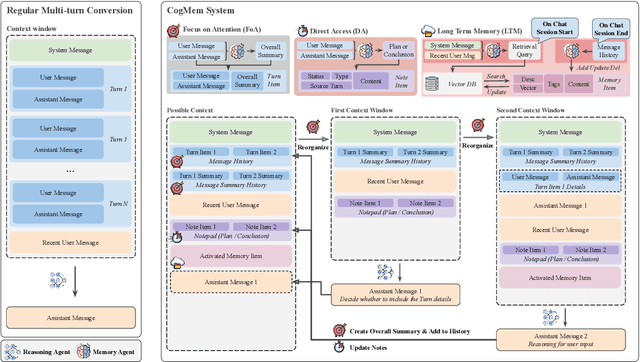
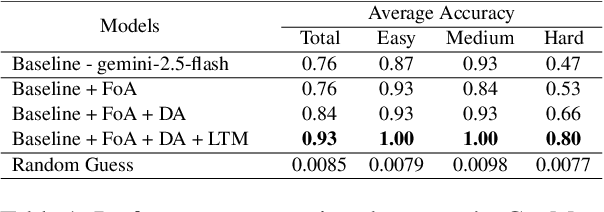
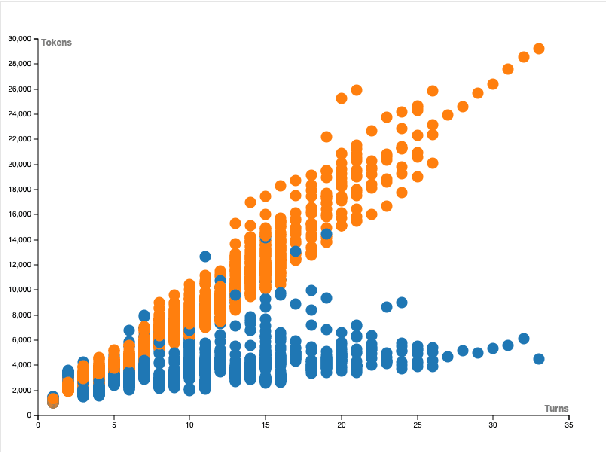
Large language models (LLMs) excel at single-turn reasoning but often lose accuracy and coherence over extended, multi-turn interactions. Recent evaluations such as TurnBench highlight recurring failure modes-reasoning bias, task drift, hallucination, overconfidence, and memory decay. Current approaches typically append full conversational histories, causing unbounded context growth, higher computational costs, and degraded reasoning efficiency. We introduce CogMem, a cognitively inspired, memory-augmented LLM architecture that supports sustained iterative reasoning through structured, persistent memory. CogMem incorporates three layers: a Long-Term Memory (LTM) that consolidates cross-session reasoning strategies; a Direct Access (DA) memory that maintains session-level notes and retrieves relevant long-term memories; and a Focus of Attention (FoA) mechanism that dynamically reconstructs concise, task-relevant context at each turn. Experiments on TurnBench show that this layered design mitigates reasoning failures, controls context growth, and improves consistency across extended reasoning chains, moving toward more reliable, human-like reasoning in LLMs.
Beyond the Black Box: Demystifying Multi-Turn LLM Reasoning with VISTA
Nov 13, 2025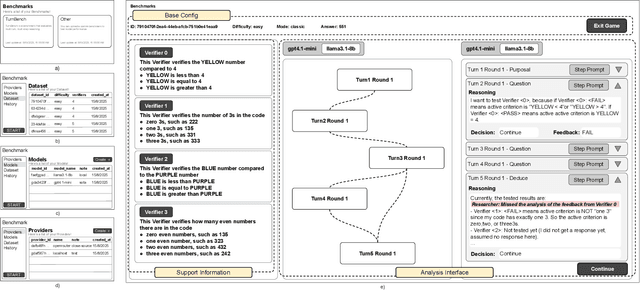
Recent research has increasingly focused on the reasoning capabilities of Large Language Models (LLMs) in multi-turn interactions, as these scenarios more closely mirror real-world problem-solving. However, analyzing the intricate reasoning processes within these interactions presents a significant challenge due to complex contextual dependencies and a lack of specialized visualization tools, leading to a high cognitive load for researchers. To address this gap, we present VISTA, an web-based Visual Interactive System for Textual Analytics in multi-turn reasoning tasks. VISTA allows users to visualize the influence of context on model decisions and interactively modify conversation histories to conduct "what-if" analyses across different models. Furthermore, the platform can automatically parse a session and generate a reasoning dependency tree, offering a transparent view of the model's step-by-step logical path. By providing a unified and interactive framework, VISTA significantly reduces the complexity of analyzing reasoning chains, thereby facilitating a deeper understanding of the capabilities and limitations of current LLMs. The platform is open-source and supports easy integration of custom benchmarks and local models.